


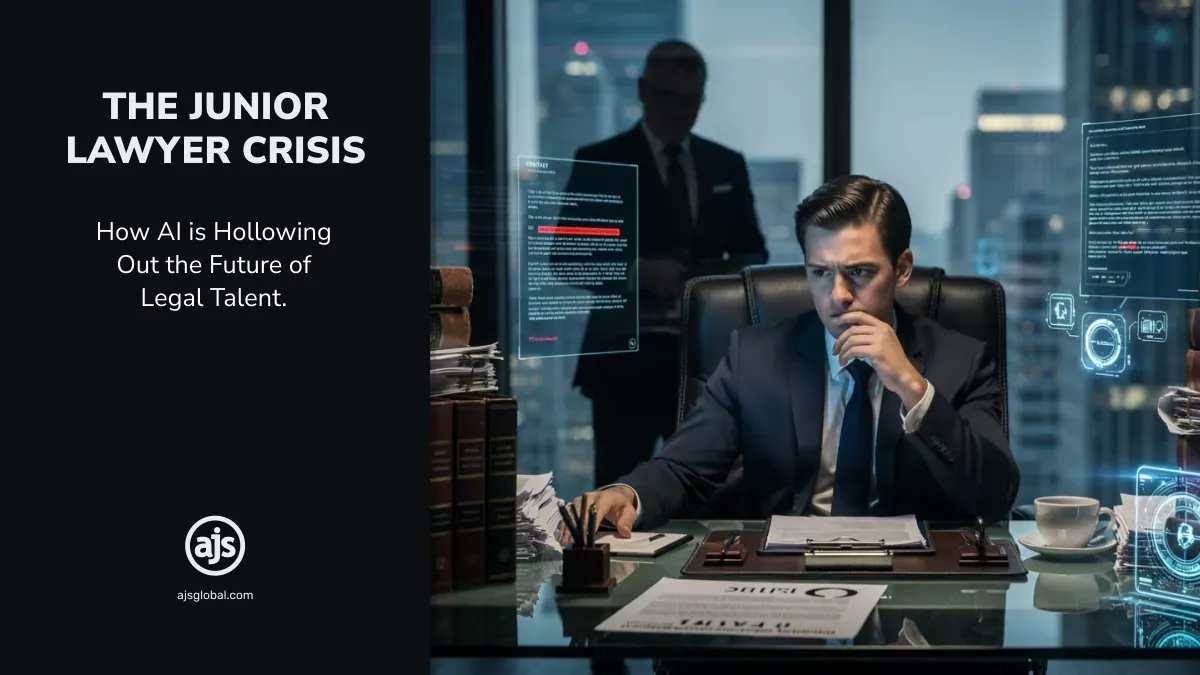
THE JUNIOR LAWYER CRISIS
How AI is Hollowing Out the Future of Legal Talent
The legal profession has long operated on a model that bears a striking resemblance to medieval feudalism, albeit with better air conditioning and more expensive stationery. I love stationery.
For decades, the industry has relied upon the reliable, rhythmic grinding of junior associates and candidate attorneys – the sacrificial lambs of the billable hour. These are the individuals tasked with the noble duty of proofreading four-hundred-page prospectuses at 3 in the morning and conducting exhaustive research into the legislative history of obscure municipal by-laws.
This wasn’t merely work, it was a rite of passage. It was the “grunt work” that supposedly tempered the raw, academic steel of a law graduate into the refined, cynical blade of a senior partner.
However, a digital usurper has entered the fray. Agentic AI and automated drafting tools have arrived, promising to liberate the legal world from the drudgery of the mundane.
The pitch is seductive – why pay a human being, with their inconvenient needs for sleep and emotional validation, to draft a standard lease agreement when a sophisticated algorithm can do it in 4 seconds flat?
On paper, this is an efficiency revolution. In practice, we are witnessing the “Talent Hollow-Out”, a phenomenon where the ladder of professional development is being dismantled while we’re still expected to climb it.
But this shift isn’t just a technological upgrade, it’s a fundamental disruption of the so-called “Apprenticeship Model” as roughly outlined by The Tilt Institute, that has sustained the profession for centuries.
The apprenticeship gap – The death of the foundational grind
The traditional apprenticeship model is predicated on the idea that wisdom is a byproduct of repetition – a learning by osmosis. One learns how to spot a fatal flaw in a contract not by reading a textbook about flaws, but by reading five thousand contracts that were perfectly fine until they weren’t.
This is the foundational craft – the thousands of hours spent in the trenches of discovery and the purgatory of due diligence. By removing these tasks and handing them over to an AI that doesn’t tire or complain, we’re inadvertently removing the training wheels from a bicycle that’s already travelling at 60km per hour.
We’re currently standing on the precipice of creating a “lost generation” of practitioners. If a junior lawyer never has to draft a rudimentary pleading from scratch because the AI provided a near-perfect first draft, they never learn the structural logic of the argument.
They become editors rather than authors!
And believe you me, there’s a profound difference between knowing why a clause is necessary and simply not deleting it because the software suggested it stay. As Marcie Bornotes Shunk and Sona Spencer note in The Death of Apprenticeship, the automation of formative training tasks risks creating a generation of lawyers strong in tech but weaker in judgment and strategy.
In the South African context, this issue is exacerbated by the rigid structures of the Legal Practice Act. The vocational training of candidate attorneys (CAs) isn’t just a firm preference, it’s actually a statutory requirement.
The Legal Practice Council (LPC) expects a CA to be exposed to the actual practice of law. Yet, if the actual practice is increasingly handled by a black box, the CA is left in a professional vacuum. We are effectively asking juniors to oversee a process they don’t yet understand.
And that’s like asking a toddler to supervise a nuclear reactor because they happen to be good at pressing the glowing buttons. Totally cute but completely ineffectual.
The myth of the “value-add” junior
Law firms have traditionally justified the exorbitant hourly rates of juniors by pointing to the sheer volume of labour performed. Now, firms face a satirical dilemma. They must convince clients that a junior associate is still worth the investment, even as the “work” that juniors used to do is being performed by a tool that costs less than a monthly coffee subscription.
The response from many firms has been to pivot to the “value-add” narrative, claiming juniors will now be freed up to perform “high-level strategic thinking”.
This, of course — and as we all know — is complete nonsense. A twenty-four-year-old who has just passed their board exams has as much “high-level strategic thinking” capability as a goldfish has an interest in macroeconomics.
Strategy is the result of seeing a hundred different ways a deal can fail and choosing the path that avoids the most spectacular explosions. Without the experience of the grunt work, the “value-add” is nothing more than a polite euphemism for “unstructured wandering”.
Evidence from a recent report supports this concern. The LexisNexis Mentorship Gap Report indicates that 72% of legal professionals worry that juniors using AI will struggle to develop deep legal reasoning and argumentation – the very capabilities developed through slow, hands-on work. Further to that is the concern – echoed by 69% of respondents – that junior attorneys won’t be able to verify and source-check their research. Vital skills required when researching matters for trial.
We are hollowing out the middle of the profession, leaving a gap between the AI that does the work and the partner who signs the bill, with a confused junior caught in the middle.
New training models – From “doing” to “auditing”
If we accept that the old world is dead – and it is – then we must reinvent the nature of legal training. We need to shift from “learning by doing” to “learning by auditing”. Sad as it may be. This sounds like a downgrade, but it’s the only viable path forward. If the AI is going to draft the document, the junior’s job is no longer to write, it’s now to interrogate.
Juniors must be trained as AI supervisors and data stewards from day one. As Stanford Law professor David Freeman Engstrom suggests, the future lawyer isn’t a document reviewer, but a “symphony conductor” who pieces together AI outputs, data, and legal scenarios. This requires a fundamental shift in the law school curriculum and the firm’s internal training programmes. The junior of the future needs to be a professional sceptic.
Their training should involve being given an AI-generated memo that contains three deliberate, subtle legal errors and being told they cannot leave the office until they find them. We must move away from the pride of authorship and instead move towards the precision of the audit.
This new model of “supervised autonomy” requires a level of transparency that law firms usually avoid like an ethics complaint. It requires admitting that the AI is doing the heavy lifting and then demonstrating that the human oversight is where the true value resides.
Leading the conversation – The Tech-First CA Programme
South Africa has a unique opportunity to lead this transition. We need a “Tech-First CA Programme” that formally integrates AI oversight into vocational training requirements. The current model, which focuses on antiquated notions of service and manual filing, is increasingly detached from the reality of modern practice. Institutions like the University of Johannesburg are already attempting to bridge this gap by embedding immersive technologies and AI into their training models.
A modernised CA programme would mandate that a portion of the two-year articles be dedicated to “algorithmic competence”. This shouldn’t be an optional extra, it should be a core requirement for admission. Candidate attorneys should be required to demonstrate proficiency in prompt engineering, data privacy, and the ethical implications of automated decision-making.
The Mavundla v MEC case in the KwaZulu-Natal High Court serves as a stark warning of what happens when AI is used without proper verification. Professor Michele van Eck has argued extensively that legal practitioners are required to present an honest account of the law, and presenting non-existent case law sourced from AI is a breach of ethical duty.
Essentially, the idea is to codify the “human in the loop” requirement. If the LPC can regulate how many hours a CA spends in a courtroom, it can certainly regulate how many hours they spend deconstructing an AI’s interpretation of a High Court judgment.
The dark satire of efficiency
There’s a certain dark irony in our current situation. We have spent decades complaining about the billable hour and the inefficiency of legal research. Now that we have a solution, we’re terrified that it works a little too well. We have built a machine that can do the “lawyering” part of lawyering, leaving us with the “client management” and “risk mitigation” parts, which are essentially just professionalised versions of babysitting and worrying.
The “Talent Hollow-Out” is not a tech problem, it’s a structural cowardice problem. We’re happy to take the efficiency gains of AI today while ignoring the fact that we’re burning the seeds we need for next year’s harvest. As Johan Steyn points out, the risk is mistaking immediate productivity for long-term development –
If AI takes over a large share of that work, then firms risk mistaking productivity for development. A junior may now produce something faster with AI support, but that does not automatically mean they understand the legal reasoning beneath it. That is the core risk. The danger is not only that AI may generate a flawed clause or a weak summary. The danger is that juniors may become editors of machine output before they have fully become lawyers in the deeper sense of the word
If we don’t change how we train our juniors, we will eventually find ourselves in a position where the most senior people in the room are the only ones who know how to do the work, and the most junior people are the only ones who know how to use the tools.
A professional call to arms
This is not a plea for a return to the “good old days” of manual research and physical library stacks. Those days were miserable. This is a call for a cold, hard look at the associate pipeline. Firm leadership must stop viewing AI as a way to cut costs and start viewing it as a tool that necessitates a complete overhaul of how they bill, how they train, and how they define “expertise”.
The South African legal community could set a global standard for how to integrate technology without sacrificing the integrity of the practitioner.
We need to stop pretending that the current model is sustainable. We’re effectively running a marathon where we’ve replaced the first 20 km with a taxi ride and are wondering why everyone is collapsing at the 30 km mark. The talent is there, but the pipeline is leaking. If we don’t fix it, the future of the legal profession won’t be a sophisticated, AI-enhanced utopia. It will be a room full of expensive computers and a few very stressed-out partners who can’t find anyone to take their place because nobody ever taught the juniors how to think for themselves.
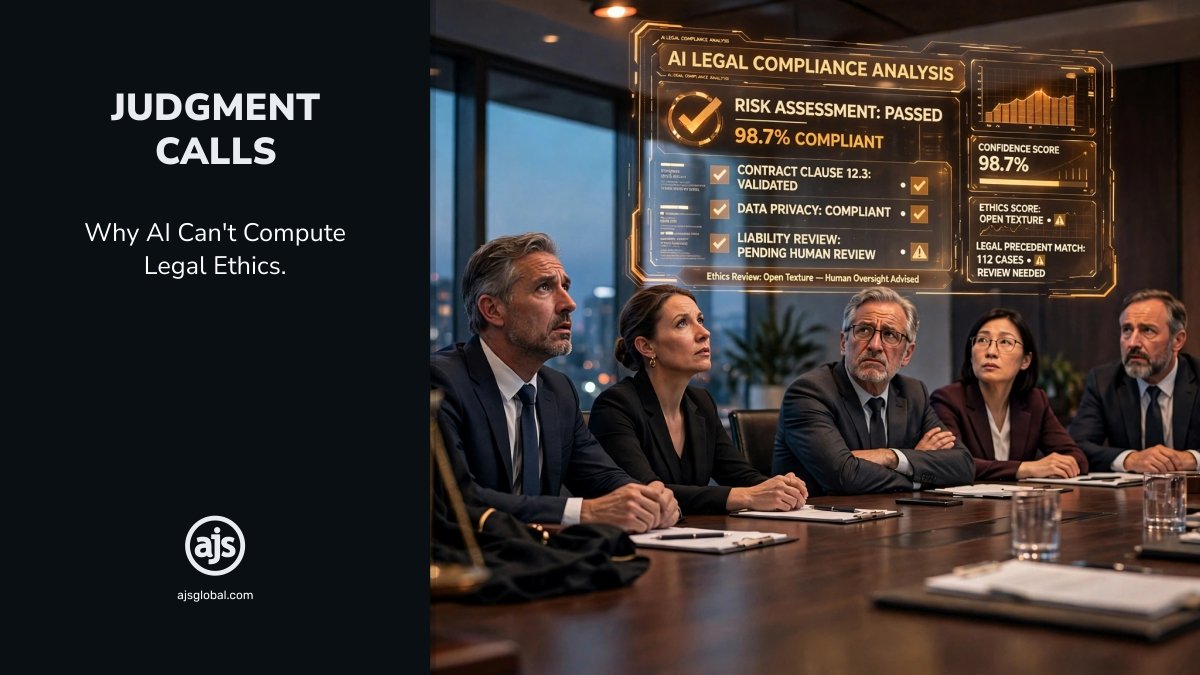
In the end, the law is about judgment. AI can simulate logic, but it can’t simulate the decades of hard-won cynicism that makes a truly great lawyer. We must ensure that our juniors have the opportunity to become that cynical, or we might as well just hand the keys of the High Court to the developers and call it a day.
While you ponder the above, and in the meantime, if you’re in need of a service provider who has a proven track record or if you want to find out how to incorporate a new tool into your existing practice management suite (or if you simply want to get started with legal tech), feel free to get in touch with AJS. We have the right combination of systems, resources, and business partnerships to assist you with incorporating supportive legal technology into your practice. Effortlessly.
AJS is always here to help you, wherever and whenever possible!
– Written by Alicia Koch on behalf of AJS
(Sources used and to whom we owe thanks – De Rebus; Axios; Lexis Nexis hereand here; Daily Maverick; The Tilt Institute; LinkedIn and ENS)
Related posts


Leave a Reply