


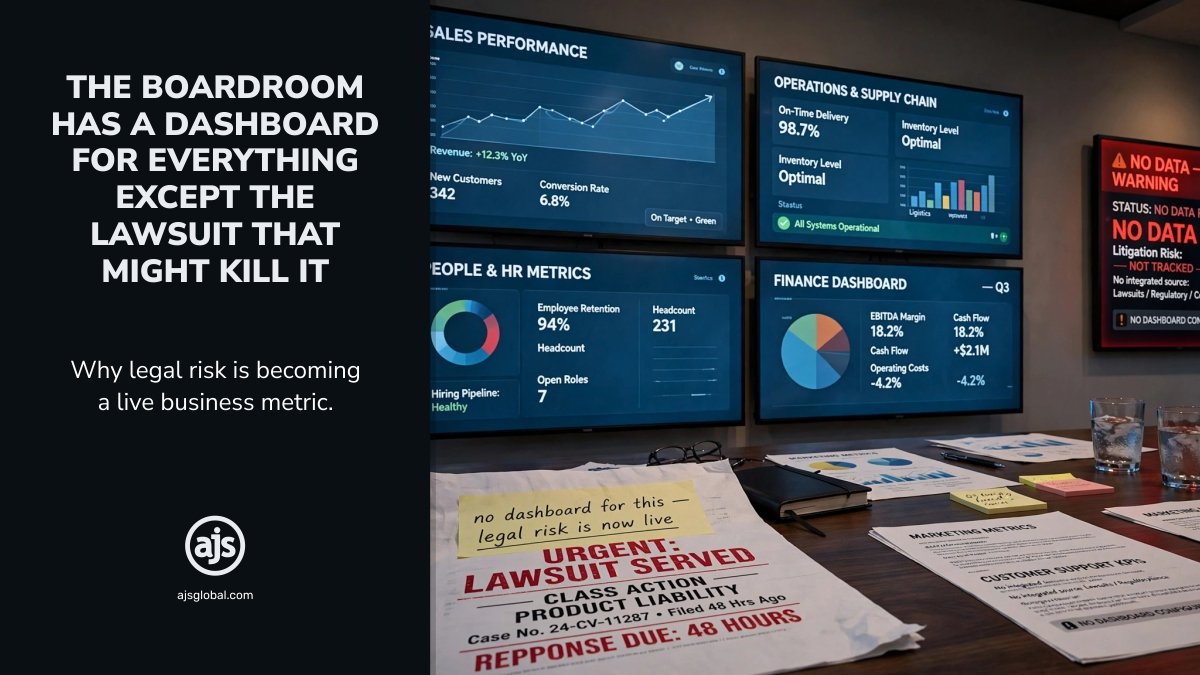
THE BOARDROOM HAS A DASHBOARD FOR EVERYTHING
Except The Lawsuit That Might Kill It
Why legal risk is becoming a live business metric…
Boards have become very good at measuring things. Sales pipelines are sliced by region before breakfast. Cash flow is stress-tested before lunch. Cyber incidents flash on dashboards with the calm urgency of a hospital monitor. Operations teams can tell you how long a container sat in a port, how many customers abandoned a cart, and whether a server in Frankfurt is having the corporate equivalent of a small nervous breakdown.
Then someone asks about legal risk, and the room suddenly develops the atmosphere of a Victorian séance. Voices drop. Someone says, “possible exposure”. A memo arrives three weeks later, generously seasoned with “subject to further review”. By then, the contract clause has already gone off, the regulator has found the unlocked cupboard, and the litigation budget has started breeding in captivity.
That gap is becoming harder to defend. If a business can track revenue, operational risk and customer behaviour as live management information, legal risk cannot remain a quarterly anecdote delivered in a font that looks as though it was last updated during the Boer War. Better matter data, contract analytics and AI-enabled legal systems are turning disputes, compliance exposure and contract risk into something executives can see early enough to do something useful.
From Legal Firefighting to Commercial Risk Architecture
For years, the general counsel has been treated as the organisation’s designated legal firefighter: calm, underfunded and expected to appear heroically once the building is already crackling. The old model rewarded reaction. A dispute emerged, documents were hunted, outside counsel was briefed, invoices arrived in their natural habitat, and the board was eventually told what had gone wrong, usually after the strategic options had narrowed to “settle painfully” or “litigate expensively”.
That model is not just inefficient. It’s commercially primitive. Early case assessment, litigation analytics and contract intelligence now allow legal teams to spot patterns across claims, clauses, jurisdictions, counterparties and spend. The American Bar Association has noted that predictive analytics can help lawyers assess litigation risk, evaluate settlement versus trial options, understand judicial patterns and refine strategy by analysing large datasets of prior matters and outcomes.
The point is not that the machine becomes counsel. Nobody sensible wants a board resolution drafted by a hallucinating toaster. The point is simpler: data can move legal risk out of retrospective storytelling and into live commercial planning. The general counsel becomes less firefighter and more risk architect, designing the legal infrastructure through which management can see exposure developing, price it, mitigate it and make better decisions while choices still exist.
Why Legal Risk Belongs on the Executive Dashboard
The case for a legal risk dashboard is blunt: boards already make decisions using live metrics. They just tolerate a strange exception for one of the most expensive categories of enterprise risk. Legal exposure affects cash flow, valuation, debt covenants, insurance, reputation, supply continuity, data governance, mergers and acquisitions, product launches and leadership attention. In other words, it touches almost everything senior executives claim to care about, except perhaps the office coffee machine, although that has probably generated a procurement dispute somewhere too.
Legal analytics makes the invisible visible. A board does not need a 40-page memo explaining that a contract portfolio contains “some risk”. It needs the sharp version: which supplier agreements lack proper termination rights, which jurisdictions are producing repeat claims, which matters are likely to breach budget, which regulatory obligations are moving from manageable to combustible, and which unresolved disputes could disrupt strategic plans.
This is not science fiction. The 2024 Wolters Kluwer Future Ready Lawyer Survey reported that 76% of legal professionals in corporate legal departments use generative AI at least weekly, and 73% of corporate legal departments plan to increase AI investment over the next three years. Thomson Reuters’ 2025 Future of Professionals Report similarly found that professionals expect AI to free up about 240 hours a year, creating an estimated annual value of US$19,000 per professional. The point is not that every legal department has suddenly become a sleek data machine. Many have not. The point is that the market is moving, and “legal is different” is starting to sound suspiciously like “we have not built the plumbing yet”.
Contract Risk: The Quiet Clause That Eats the Business
Most corporate disasters don’t arrive with theme music. They arrive as clauses nobody read with enough fear. A limitation of liability provision that quietly collapses under pressure. A renewal clause that traps the business in an absurdly expensive relationship. A force majeure clause drafted before supply chains became a global hostage negotiation. A data processing agreement described as “standard”, which is often corporate shorthand for “we didn’t want to negotiate it and now it owns us”.
Contract analytics can turn that buried risk into live intelligence. Instead of asking whether the legal team has reviewed “material contracts”, leadership can ask better questions: How many critical supplier agreements contain weak termination rights? Which customer contracts contain uncapped liability? Which jurisdictions have outdated privacy wording? Which revenue lines depend on counterparties with deteriorating dispute histories?
That’s the real shift: legal review stops being a bottleneck and starts becoming a management layer. It doesn’t replace judgement. It gives judgement a better map, and fewer chances to wander cheerfully into a swamp.
Compliance Risk: Regulation Is Now a Moving Target
Compliance used to pretend it was a filing cabinet. That was sweet. Today, regulation behaves more like weather: regional, volatile, occasionally violent and usually noticed too late by the people standing outside without an umbrella – “I’m singing in the rain” …
Data protection is the obvious example. The European Commission explains that GDPR enforcement may include warnings, reprimands, bans on processing and fines of up to €20 million or 4% of worldwide annual turnover. In South Africa, POPIA offences can attract serious penalties, including fines and imprisonment for certain contraventions, with widely cited maximum administrative fines of up to R10 million. None of that belongs in the “legal detail” drawer. It’s board-level financial and operational exposure.
A live legal risk system can monitor regulatory obligations against what the business is actually doing: breach notification timelines, consent records, cross-border transfers, vendor processing terms, data subject requests, sector-specific duties and policy changes. It can flag where the business is drifting away from compliance before a regulator writes the kind of letter that makes everyone suddenly very interested in governance.
The boardroom benefit is not compliance theatre. It’s allocation. A CEO can decide where to spend remediation budget. A CFO can model possible exposure. A CIO can prioritise systems. A general counsel can explain legal risk in business language without performing the ancient ritual of “it depends” until the room loses the will to live.
Litigation Analytics: Turning Disputes Into Decision Data
Disputes have always involved uncertainty. That doesn’t mean they must be managed as superstition. Litigation analytics can help identify patterns in outcomes, court behaviour, timelines, opposing counsel tendencies, settlement ranges and procedural risk. Lex Machina’s 2025 legal analytics survey reported that more than 95% of respondents viewed analytics as valuable, with seven out of ten actively using analytics in litigation practice. Analytics aren’t all-knowing. They’re just mainstream enough that ignoring them now feels less like prudence and more like choosing to navigate Sandton traffic by horoscope.
For executives, the practical value is obvious. A dispute with a high probability of an adverse outcome is not only a legal matter. It’s a pricing issue, an investor communication issue, a budgeting issue and sometimes a strategy issue. If a claim threatens a key product line, a major customer relationship or a planned acquisition, the board shouldn’t first see that risk when the matter is already wearing a trial date like a LBD.
The strongest legal departments won’t merely report open matters. They’ll rank exposure, model scenarios, link legal events to financial consequences and explain recommended action in language that makes sense outside the legal department. That’s when legal becomes strategic rather than ceremonial.
The Dangerous Seduction of the Pretty Dashboard
Of course, dashboards bring their own deliciously modern danger: executive overconfidence. Give a board a red, amber and green system and, within six minutes, someone will confuse colour-coding with wisdom. A dashboard isn’t governance. It’s a governance instrument. If the data is poor, the model is biased, the thresholds are arbitrary or the users don’t understand the assumptions, the dashboard simply helps the organisation make bad decisions faster and with nicer icons.
This matters because directors can’t outsource judgement to a machine, no matter how attractive the interface is. AI-enabled risk systems must be explainable enough for leadership to understand what is being measured, how confidence levels are calculated, where the data comes from and when human review is mandatory. The best organisations won’t ask only, “What does the model say?” They’ll ask, “Why does it say that, what are its limits, and who is accountable for acting on it?”
That’s especially true in legal work, where privilege, confidentiality, accuracy and bias aren’t charming optional extras. Wolters Kluwer’s 2024 survey also highlighted integration, trust in AI outputs, ethics and data privacy as continuing challenges for legal professionals adopting generative AI. A legal risk dashboard must therefore be governed like a serious business system, not installed like a clever toy brought back from a conference.
How to Build a Live Legal Risk Dashboard
The first step is painfully unglamorous: clean the data. Most legal departments can’t produce live legal intelligence because their information is scattered across inboxes, spreadsheets, shared drives, law firm portals and the institutional memory of one senior person whose currently on leave. Before the board gets a dashboard, the organisation needs a reliable system of record for contracts, matters, claims, obligations, documents, spend and outcomes. Boring? Yes. Optional? Not if you want the dashboard to be more than executive wallpaper.
Then define the metrics that actually matter. Not everything legal can, or should, become a number. But many board-relevant risks can be translated into useful indicators: estimated value at risk, probability-weighted exposure, matter age, burn rate, settlement range, contract deviation frequency, compliance breach severity, regulatory change impact and repeat-counterparty risk.
After that, connect legal metrics to business consequences. A contract risk score is only useful if it tells management what might happen to revenue, delivery, customers, valuation or reputation. Legal dashboards shouldn’t exist as decorative compliance furniture. They must inform choices: renegotiate, reserve, settle, litigate, redesign, disclose, insure, pause, accelerate or exit.
And keep humans firmly in the loop. Lawyers must validate outputs, challenge assumptions and explain uncertainty. Technology should make legal judgement faster and more disciplined. It shouldn’t replace it with automated confidence theatre. The best algorithmic boardroom is one where the general counsel can say, plainly: “Here is the exposure, here is why it changed, here is what we recommend, and here is what happens if we do nothing”.
The General Counsel as Business Risk Architect
This is where the general counsel’s role becomes more interesting and, frankly, more dangerous for anyone who preferred the old comfort of being consulted after the decision had already been made. A live legal risk function puts the general counsel closer to strategy, pricing, product design, data governance and capital allocation. It also means legal advice can be measured against outcomes. Thrilling, if by thrilling we mean mildly terrifying and long overdue.
The commercial value is that legal stops being the department of “no” and becomes the department of “not like that, unless you enjoy preventable ruin”. That’s a better proposition for boards. It gives executives enough visibility to take informed risks rather than accidental ones. It also gives legal teams a stronger voice, because quantified risk tends to travel better than elegant anxiety.
The strategic question for boards isn’t whether legal risk can be fully predicted. It can’t. Judges remain human. Regulators remain regulators. Counterparties remain capable of behaviour that would embarrass a raccoon. The question is whether leadership can see enough, early enough, to make better commercial decisions.
The Boardroom Needs Fewer Anecdotes and Better Legal Data
Legal risk is moving out of the dusty litigation file and into the live management layer of the business. That move will not be tidy. It’ll involve data quality problems, governance debates, uncomfortable metrics and at least one executive who asks whether “the AI can just tell us if we are fine”. It can’t. Nothing serious can. But it can help identify where the business is not fine before the discovery process makes that point more expensively.
The organisations that win will be the ones that treat legal exposure as a live operational variable: measured, challenged, governed and connected to strategy. The organisations that don’t will continue receiving quarterly legal updates in which the most important corporate risk is described as “developing”. That’s not a risk management system. That’s a weather report after the flood.
Bring Legal Risk Out of the Filing Cabinet
If your board can see cash flow, sales performance and operational risk in real time, it can survive seeing legal risk before it arrives with counsel, costs and a face like thunder. AJS helps legal teams and business leaders turn contracts, disputes and compliance obligations into clearer, more useful management information — the kind boards can act on before “developing risk” becomes “urgent external counsel required”. Because “we’ll deal with it when it becomes a problem” isn’t a strategy. It’s just negligence wearing a calendar invite.
– Written by Alicia Koch on behalf of AJS
(Sources Used and to Whom We Owe Thanks – American Bar Association — “Using AI for Predictive Analytics in Litigation”, 16 October 2024; European Commission — “What if my company/organisation fails to comply with the data protection rules?” ; GDPR-info.eu — “Article 83 GDPR: General conditions for imposing administrative fines.” ; LexisNexis / Lex Machina — “Lex Machina 2025 Legal Analytics Survey: From Important to Essential”, 17 July 2025; POPIA — “Section 107 Penalties.”; Michalsons — “POPIA offences, penalties and administrative fines.”; Thomson Reuters — “Future of Professionals Report 2025.”; Wolters Kluwer — “The 2024 Wolters Kluwer Future Ready Lawyer Report.” and Wolters Kluwer — “Future Ready Lawyer Survey 2024: Legal professionals confident in managing AI-driven changes to business of law”, 24 October 2024)
Related posts



Leave a Reply