


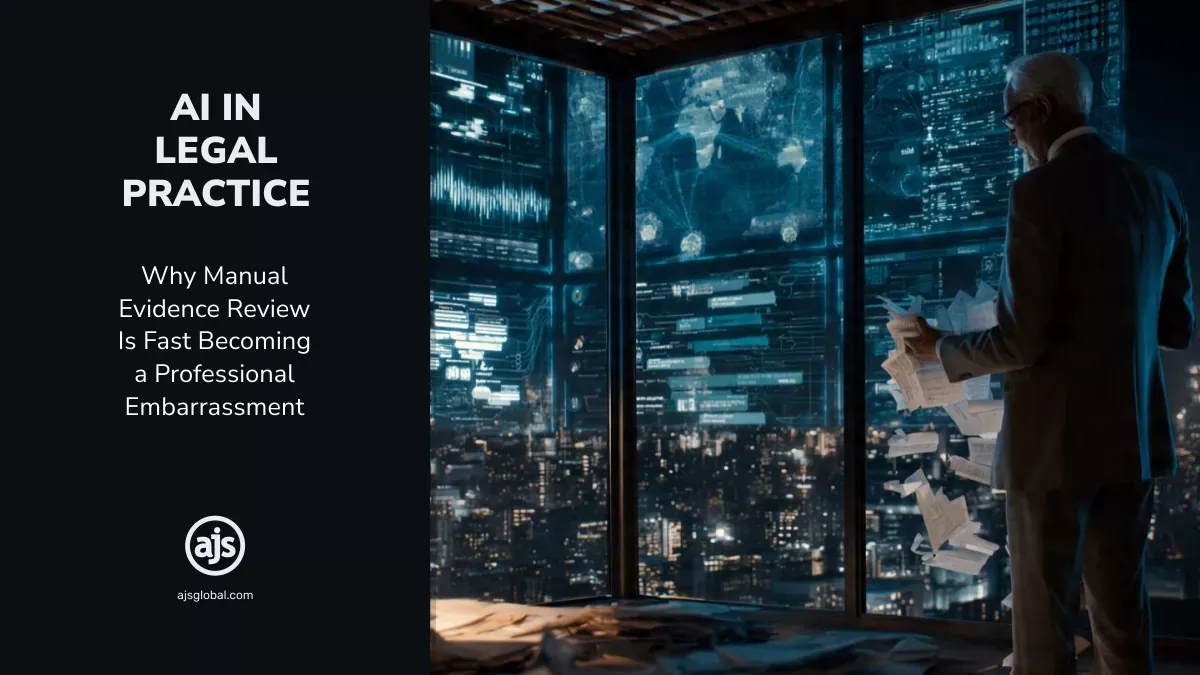
AI IN LEGAL PRACTICE
Why Manual Evidence Review Is Fast Becoming a Professional Embarrassment
Let’s stop pretending manual document review was ever a sacred craft. It survived because it was profitable. For years, the profession confused labour intensity with legal excellence, billed armies of junior associates to read oceans of corporate data and sold the whole exercise as judgement. It wasn’t judgement. It was a revenue model with a respectable accent.
Then we wrapped that revenue model in mythology. Somewhere in the archive, we told ourselves, a heroic associate would uncover the one fatal email that makes the case collapse on cue. It’s a flattering fantasy because it keeps the old economics intact. It’s also the kind of fantasy professions cling to right before reality humiliates them.
What once passed for diligence is starting to look a lot like professional self-deception.
The traditional “smoking gun” is dead. Modern evidence doesn’t sit politely in one foolish email waiting to be discovered by a caffeine-fuelled associate at 03:00. It’s scattered across voice notes, encrypted chats, geo-location logs, Slack channels, Team chats, and metadata trails so dense that manual review is less a method than a confession of scale failure. No individual can see it all. No conventional team can connect it all in time. So let us stop calling manual review a mark of rigour. In too many matters, it’s simply the profession’s most socially accepted way of missing the point.
Stop Calling It a Tool – The Rise of the Algorithmic Witness
One of the profession’s favourite evasions is to call artificial intelligence a mere “tool”. The word is doing a remarkable amount of emotional labour. It makes lawyers feel in control of a shift they aren’t controlling. A printer is a tool. A database is a tool. A system that reconstructs timelines, cross-references testimony, detects behavioural anomalies and surfaces patterns no human mind could ever hold at once isn’t a tool in any old-world sense that matters. It’s a new evidentiary force, and the profession is still trying to minimise it with timid language.
The euphemism has expired. When an advanced legal intelligence system digests millions of data points and builds a narrative timeline no human mind could map, it has crossed the line from passive utility to active evidentiary force. It’s no longer just a tool in the room. It’s the Algorithmic Witness, and many lawyers haven’t yet realised that it has already entered the courtroom.
Consider the shift in perspective this demands. A human witness takes the stand to recount what they observed within a limited and imperfect cognitive horizon. The Algorithmic Witness, by contrast, testifies to patterns across an entire corporate universe. It doesn’t merely look for the word “bribe”. It observes that every time Executive A sent an apparently innocent WhatsApp voice note about “the weather in Cape Town”, a corresponding financial transaction began in an offshore account three minutes later, while Executive B’s mobile device pinged a cell tower outside a specific branch office.
The Algorithmic Witness doesn’t speak in human adjectives. It speaks in statistical probabilities. It doesn’t guess intent. It maps behavioural structure. When you introduce this level of analytical power into a dispute, you’re no longer conducting a traditional document review. You’re putting an entity on the stand that has effectively memorised every word your client has spoken, typed, or implied over five years.
The Malpractice Question the Profession Keeps Avoiding
Here’s the scenario the profession prefers not to discuss. It is 2027. You’re defending a high-profile corporate executive accused of market manipulation. The prosecution dumps 10,000 WhatsApp voice notes, half a million Slack messages and four terabytes of unstructured data into discovery.
You trust the “human touch”. So, you assign three junior advocates to the audio. They work hard for weeks. They bill a fortune. They assure you the defence is ready.
Then trial starts. Opposing counsel rises with an advanced multimodal AI engine. In minutes, it analyses all 10,000 audio files, maps vocal tone, transcribes colloquial South African slang, and matches it against the ledger. It finds the contradiction that kills your case – a casual Friday-afternoon voice note from Sandton that directly undermines the affidavit your client signed three years later.
You never found that contradiction. Your associates missed it because it appears in minute four of an otherwise unrelated audio clip in which your client is mostly discussing his golf handicap.
Now answer the only question that matters – Did you provide a competent defence?
In South Africa, the courts have already issued clear warnings on technology and professional standards. In Mavundla v MEC: Department of Co-Operative Government and Traditional Affairs KwaZulu-Natal and Others [2025] ZAKZPHC 2, the KwaZulu-Natal High Court dealt with fictitious authorities in court papers and referred the matter to the Legal Practice Council. More recently, in Northbound Processing (Pty) Ltd v The South African Diamond and Precious Metals Regulator and Others, the Gauteng High Court again addressed AI-generated fictitious citations and reinforced the duty of legal practitioners to verify authorities against reliable sources.
If the court demands technical precision, why would clients tolerate anything less? If AI could have found the exculpatory evidence in 20 minutes and you spent six months missing it by hand, this’s not diligence. It’s avoidable failure billed at premium rates. The profession should stop asking whether AI introduces risk and starts confronting the far less comfortable question – in some matters, is refusing to use it already indefensible?
Addressing the Constitutional Fair Trial Dilemma of Algorithmic Asymmetry
This disparity creates an existential crisis for our justice system – Can we seriously keep calling a trial fair when one side uses AI to find evidence the other side is structurally incapable of seeing?
Read that again.
Our legal framework rests on the eighteenth-century assumption of a level playing field. Two opposing minds, matched in intellect and resources, present their best arguments before an impartial arbiter. Equality of arms is central to constitutional fairness.
But what happens when one side replaces their human eyes with an algorithmic lens that operates in a higher cognitive dimension?
If Firm A relies on manual review, it scans documents sequentially and looks for explicit meaning. If Firm B uses a fully integrated deep-learning model, it views the digital universe as a multi-dimensional semantic map. It can detect subtle systemic anomalies across millions of transactions that no human mind could identify, even with a hundred years to read the files.
This isn’t an academic debate. Not anymore. It‘s a redistribution of power. In complex litigation, a lawyer facing an AI-driven opponent isn’t merely under-equipped. They’re operating inside an obsolete theory of advocacy. At that point, the trial is no longer a contest of principle or truth alone. It’s a contest of cognitive leverage, and the side without algorithmic augmentation is fighting blind while insisting it can still see perfectly well.
Analysing E-Discovery Technology Regulations and Case Law
This transition is not a futuristic theory. It’s already under way in high-stakes corporate courtrooms around the world.
The South African Landscape
In South Africa, the landscape is shifting under the weight of data volume. The Protection of Personal Information Act (POPIA) has introduced strict compliance requirements for data processing. Yet in large corporate investigations, including complex commercial fraud and liquidation matters, the volume of electronic data routinely paralyses traditional legal teams. Forward-looking local firms are already moving beyond manual keyword searches and deploying advanced e-discovery engines to explain multilingual data, recognising that courts have little patience for delays caused by outdated administrative workflows.
Global Precedents
Overseas, the regulatory and judicial pressure is even more explicit. In the United States, federal courts have long penalised parties for inadequate electronic discovery processes under the Federal Rules of Civil Procedure. In major corporate litigation, firms that fail to use technology-assisted review (TAR) face sanctions, preclusion orders, or catastrophic default judgments when discovery failures conceal vital evidence. Malpractice insurers in Europe and North America are also scrutinising firm technology stacks more closely. The logic is simple – a firm that refuses to use AI to verify and review evidence is at a significant insurance risk.
From Detective to Final Arbiter – The Evolution of Modern Law Firms
Here lies the ultimate irony for the legal traditionalist. The very technology you resisted because you feared it would replace you may be the only thing that preserves your professional relevance.
The profession needs a more honest self-image, and perhaps a less flattering one. Stop calling yourself the “Detective”. That archetype survives because it flatters the ego, not because it still describes the work. If you keep clinging to it, you will keep charging clients to search the wrong terrain while the decisive patterns emerge somewhere your team never even thought to look.
Instead, the modern legal professional must step into the role of The Final Arbiter.
The AI can surface the needle, the pattern, the contradiction, and the anomaly. What it cannot do is carry consequence. It cannot weigh human cost, judge the political risk of an aggressive defence strategy, persuade a judge with moral force, or guide a board through the reputational fallout of scandal. That’s your remaining claim to value.
The future of the profession isn’t competing with the machine on scale. It’s proving that you still matter where scale ends and judgement begins.
The era of charging premium rates for manual document skimming is ending, and the profession won’t get to narrate that ending on its own terms. As 2027 approaches, the line between traditional practice and professional negligence is becoming too thin to hide behind. The firms and corporations that survive this shift won’t be the ones defending old methods with nostalgic language. They’ll be the ones willing to abandon professional theatre in favour of genuine capability.
AJS’s Position on AI Capability
AJS is closely watching the rapid evolution of these AI engines and sees significant potential for future integration and partnership where it adds real value to legal workflows. We find the technology compelling and are actively positioning the software suite to align with this direction over time. For now, our focus remains on delivering practical, proven tools that strengthen legal process and professional judgement, while building toward a future in which AI will form part of the broader suite.
Don’t let your firm become the case study others use when they talk about professional inertia. Equip your legal teams to handle modern corporate data with speed, precision, and strategic control.
If this has sparked a serious conversation about modernising your legal function, adopting legal technology or extracting more value from the systems you already have, feel free to get in touch with AJS. We help legal teams use practical tools in ways that strengthen professional judgement and expose where legacy workflows are no longer good enough.
AJS is always glad to help legal teams work smarter without losing what makes good legal work good in the first place.
– Written by Alicia Koch on behalf of AJS
(Sources referenced: Mavundla judgment; Northbound Processing judgment; Cliffe Dekker Hofmeyr; Moonstone; De Rebus; Haystack ID; Legalbrief Africa; Holland & Knight Law and First Legal)
Related posts


Leave a Reply