


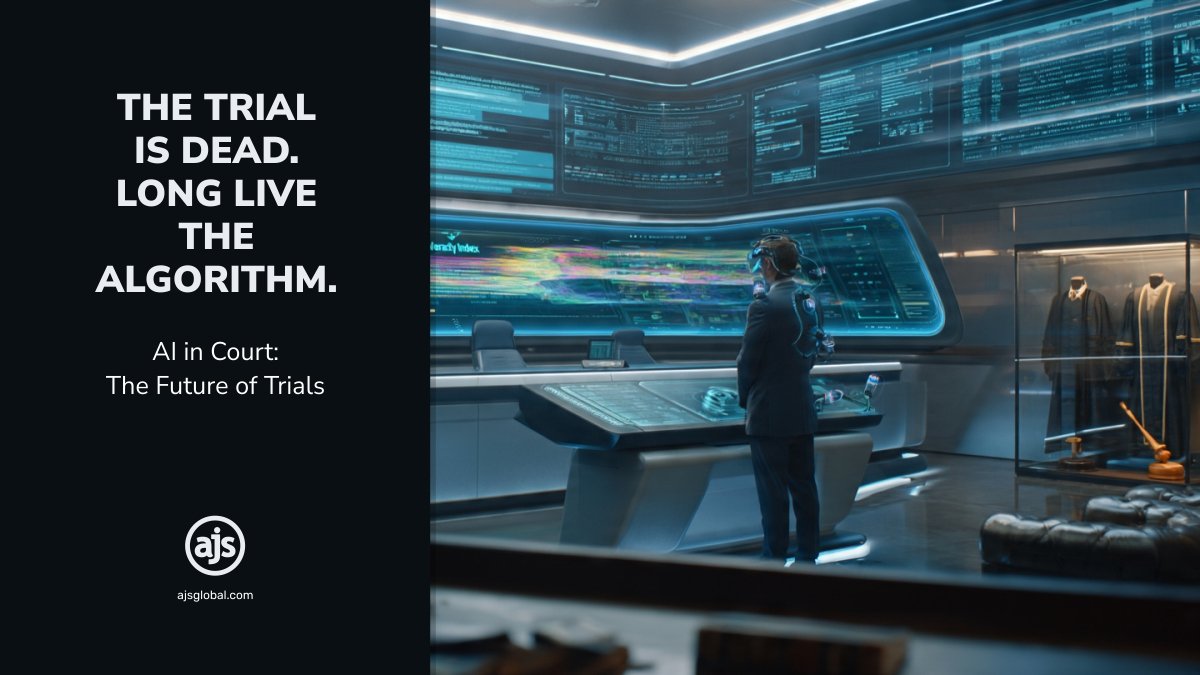
THE TRIAL IS DEAD. LONG LIVE THE ALGORITHM
AI in Court: The Future of Trials
Welcome to the modern courtroom. Step inside but leave your vintage illusions of dramatic human rhetoric at the biometric scanning turnstile. It’s 2027, and the legal profession has undergone its long overdue, faintly terrifying and highly profitable digital lobotomy.
The real threat isn’t that machines will make trials faster. It’s that they may make the trial itself look like a ceremonial relic, complete with robes, Latin and a disturbingly resilient catering budget.
Remember the good old days? You’d stand before a judge, adjust your silk tie, clear your throat with intent, and deliver an opening designed to move everyone except the person calculating costs on the back bench. It was slow. It was inefficient. It was wonderfully expensive.
Well, clear out your desk, Cicero. The performance art is dead.
Today, we don’t “introduce” evidence. We stream it. We don’t argue the facts. We adjust optimisation models. The modern trial no longer crawls through discovery, affidavits and paper cuts. It executes in milliseconds across decentralised data layers. For CEOs, managing partners and general counsel, this looks like the promised land – a hyper-efficient paradigm in which human error has been engineered out of the budget, along with much of your billable time.
But the uncomfortable question arrives early – if the evidence is continuous, verified and predictive, what exactly is left for the trial to do?
The real-time infrastructure
Consider the entirely fictional, though spiritually accurate, high-stakes battle of OmniCorp International v Apex Quantum Logistics (2027). A few years ago, this multibillion-rand breach of contract suit would’ve occupied an entire floor of a major commercial firm. A small army of junior lawyers would’ve reviewed six million emails to decide whether a vice-president’s smiley-face emoji amounted to a waiver of a condition precedent.
By 2027, we don’t do that. The foundations were laid in 2026, when legal technology moved from standalone software experiments to embedded, agentic AI workflows and integrated cloud frameworks. Both companies now plug directly into a neutral, court-sanctioned judicial Application Programming Interface (API). When Apex Quantum failed to deliver suborbital shipping manifests, an automated smart contract flagged the anomaly, triggered a litigation hold and initiated a precompiled civil complaint before the warehouse supervisor had finished washing his hands.
Evidence in 2027 is a continuous river of digital reality – a real-time cryptographic feed. Internet of Things (IoT) sensors track shipping containers. Deep-learning models study procurement directors during video calls. Every Slack message, Teams chat, stock trade and micro-expression is ingested, timestamped and anchored to a sovereign legal ledger.
In South Africa, where POPIA already makes data governance more than a compliance hobby, this isn’t merely futuristic theatre. It’s a reminder that tomorrow’s legal argument may depend on today’s records management, consent architecture and audit trail.
Opposing counsel no longer stands up to shout, “Objection! Lack of foundation!” The foundation is verified before the data reaches the judge’s display. To object to the evidence is to object to mathematics, which remains a brave but commercially unrewarding litigation strategy.
Back in 2026, courts and commentators were already treating digital evidence as the default record, while mandating strict security, compliance and defensible validation standards. In 2027, a few old-school litigators still try to cross-examine a cloud database cluster. The results are generally regarded as a dark stain on a firm’s reputation.
The death of the statement of truth
This brings us to the crown jewel of the 2027 judicial apparatus – the execution of the human witness statement. For centuries, the legal system relied on a charmingly naïve concept called the “statement of truth”. Everyone knew it was a polite fiction – a sanitised, legally armoured narrative drafted by a junior lawyer, edited by a partner and scrubbed of spontaneity until it read like a washing-machine manual.
In 2027, the statement of truth is no longer paper signed with a Montblanc pen. It’s an algorithmic data score. When a senior executive takes the virtual stand, they don’t raise a right hand. They consent to live biometric, neural and linguistic analysis as the courtroom’s AI engine tests vocal pitch, galvanic skin response, micro-tremors and semantic consistency against 20 years of digital history.
The screen above the witness box displays a real-time “Veracity Index”, a pulsing, colour-coded score that fluctuates with every syllable. If the CEO says, “We always prioritised quality control over quarterly margins”, it drops from green 0.94 to crimson 0.12, cross-references 5 000 emails, three deleted WhatsApp voice notes and an anonymous Glassdoor review, then flashes them across the monitors within three nanoseconds.
The problem, of course, isn’t that the machine is always right. It’s that everyone in the room eventually behaves as though it is.
This scrutiny grew out of the mandatory AI verification certificates and judicial warnings against unverified, hallucinated data input that shook international and South African courtrooms in 2026. South African courts had already shown little appetite for phantom authorities and AI-assisted legal fantasy, with fictitious citations attracting the sort of judicial attention no practitioner puts in a brochure.
Cross-examination is no longer a duel between a brilliant Advocate and a stubborn witness. It’s data reconciliation. The Advocate doesn’t trap the witness in a lie. The algorithm informs the court that the witness’s statements are mathematically incompatible with reality.
The executive’s new wardrobe
For the C-suite, this leap requires adjustment. The traditional corporate armour – confidence, charisma and the ability to deliver a hollow platitude with absolute conviction – is no longer an asset. It’s a liability. The executive of 2027 doesn’t want a lawyer who can charm a court. They want someone who can optimise their behavioural data footprint before anyone sues.
We’re seeing the rise of the algorithmically clean executive – leaders who speak in short, declarative, verifiable sentences. “I approved the transaction. The budget was sufficient. The returns were satisfactory”.
Any metaphor, irony or corporate jargon sends the Veracity Index into spasm as the AI decides whether a “synergistic paradigm shift” is a fraudulent misrepresentation of asset value or merely a cry for help from investor relations. There’s no room for personality in 2027.
Senior leadership teams are no longer judged only by share-price growth, but by systemic predictability. A volatile CEO whose biometric truth score drops without warning is a walking compliance hazard. The machine demands uniformity, and the market, as ever, complies.
When the trial becomes theatre
By the time the OmniCorp trial enters its fifth week, a strange epiphany settles over the boardroom. The proceedings have been spectacularly precise. No procedural bickering, emotional outbursts or scheduling disasters. The data streams have flowed. The AI has adjusted liability probabilities. The entire history of both enterprises has been exposed, quantified, categorised and indexed with clinical perfection.
It’s here, during a Thursday afternoon data sync, that senior executives, general counsel and board members look at one another through telepresence screens and articulate the terrifying, obvious question lingering like a bad smell –
But if the trial is this precise, do we even need to go to court at all?”
The realisation lands like ice water over silk pyjamas. “Going to court”, even a virtual, AI-driven court, is a vestigial organ of an analogue beast. It’s a multimillion-rand re-enactment performed because we haven’t yet had the courage to let the software finish the job.
We’ve built an architecture capable of analysing petabytes of corporate data in real time. We’ve eliminated human bias, fatigue and eloquence. Yet we still stage this digital carnival for weeks, watching a computerised judge render a computerised verdict on computerised data while human lawyers charge by the hour to monitor bandwidth.
The trial has become redundant. If probabilistic litigation engines and predictive analytics can calculate the outcome before proceedings begin, continuing the trial is not justice. It’s vanity with a time sheet. And an expensive Mercedes-Benz.
The question isn’t whether the system is faster. It’s whether speed, dressed up as certainty, can quietly swallow fairness whole.
The autonomous resolution era
So, what lies beyond 2027?
The answer is as simple as it is inevitable – the disappearance of dispute resolution as we know it. We’re moving towards “continuous predictive settlement”. Corporations won’t wait for a breach of contract, nor file lawsuits when things go wrong. Their enterprise risk engines will monitor supply chains, market fluctuations, contractual obligations and internal communications, see disputes brewing months before humans do, calculate liability and execute micro-settlements through automated banking rails.
The dispute is identified, litigated, adjudicated, settled and paid in the time it takes a human lawyer to type – “Dear Sirs, we write further to our letter of…” There are no courtrooms, judges or late-night settlement conferences fuelled by cold pizza and warm white wine. There’s only the smooth reallocation of capital across balance sheets, managed by algorithms that don’t sleep, don’t drink and don’t expect equity at year-end.
The human ornament
Where does this leave the human legal elite? Don’t despair, colleagues. The technology companies will still need you, albeit in a less glamorous capacity. You won’t argue constitutional principle before a rapt audience. You’ll be rebranded as a “legal data steward” or “algorithmic prompter”, ensuring the servers don’t overheat and occasionally adjusting the judicial AI’s tone so its verdicts sound sufficiently solemn.
You’ll still wear expensive suits, of course, but in a windowless room, staring at a dashboard as green lights flicker and automated settlements pulse through the ether.
You’ll be the caretaker of a magnificent, ghost-filled machine – the human ornament on an automated judicial engine.
And for CEOs and senior executives? You’ll finally get what you always wanted – predictability, speed and a legal department that never talks back, asks for a raise or tells you that your business strategy is technically a criminal offence with a litigation budget. You’ll have traded the messy, human pursuit of justice for the clean, cold efficiency of an optimised ledger.
Magnificent.
Just remember to back up your systems, because if the server goes down, justice ceases to exist entirely, and nobody wants to go back to talking to one another.
So, before the algorithm starts practising its judicial smile, ask the uncomfortable questions. Where does your evidence live? Can you trust the data trail behind your contracts, decisions and approvals? Would your organisation survive a forensic reconstruction of its digital memory, or would the servers hand the court a horror novel with annexures? The sensible move isn’t to panic, posture or order another glossy strategy deck. It’s to get your information architecture, governance and legal processes into a condition that won’t embarrass you when the machine reads them back aloud. The future courtroom may not ask whether your organisation has a legal argument. It may simply ask whether your data remembers the same story you do.
AJS’s Version 6 already includes some AI compatibility, which is useful, but not quite the moment to release doves over the data centre. The serious work is quieter – helping legal teams use technology in ways that are governed, practical and useful when the language of “transformation” has left the meeting room and someone still has to find the document, prove the approval and explain why the system contradicts the board pack.
For teams modernising their operating model, these questions are no longer theoretical. They’re part of the job. AJS works with organisations facing that transition, strengthening professional judgement, improving the evidence trail and identifying which parts of the old process are only alive because nobody has had the heart to switch off the lights.AJS helps legal teams modernise with a clear view of what technology should do, and what it should not pretend to do.
– Written by Alicia Koch on behalf of AJS
(Sources used and to whom we owe thanks – AI in Legal Tech: 5 Predictions for 2026, Tech4Law; 7 Legal Tech Trends to Watch in 2026, The Compliance Digest; February 2026: Legal Tech, AI and the Digital Practice of Law, Lakisha Bealer MBA, LinkedIn; The AI Legal Tech Forecast 2026: What’s Working Now and What’s Next, TrustArray; Authenticating Evidence in the Age of AI, International Bar Association; There Is No AI in the Courtroom, Mail & Guardian; Another episode of fabricated citations, real repercussions: South African courts show no tolerance for AI-hallucinated cases, Cliffe Dekker Hofmeyr; The implications of POPIA in the use of AI in South African litigation, Fairbridges Attorneys; Portable integrity: authenticating cross-border digital evidence and defending AI review in commercial disputes, International Bar Association; and 7 Legal Tech Trends That Will Reshape Every Business in 2026, Bernard Marr, LinkedIn)
Related posts


Leave a Reply